


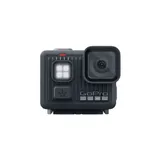
LIT HERO (2025)
- Minimal difference in baseline resolution and framerates, but the Quik app's video stabilization gives the LIT HERO a massive edge.
- Major hardware upgrades, including 1TB microSD support, a rear touchscreen, an LED light, and magnetic mounting.
- Given the inevitable battery degradation of older hardware, there is very little reason to pick up a HERO5 Session today.
Key Factors
Video Quality
Similar baseline resolution, but a massive gap in stabilization thanks to Quik app HyperSmooth.
Hardware & Features
Significant upgrades with 1TB microSD support, a rear screen, LED lighting, and magnetic mounting.
Size & Weight
The cube-shaped HERO5 Session remains noticeably smaller and lighter.
Similar image quality, but a massive gap in stabilization
The 2025 LIT HERO and the 2016 HERO5 Session are separated by nearly nine years of tech evolution. Yet, if you look strictly at baseline specs like resolution and framerates, the difference isn't quite as drastic as you might expect.
The LIT HERO tops out at 4K/60fps, giving you the edge of 2x slow motion in 4K. That said, the HERO5 Session still holds its own: it handles 4K/30fps, 1440p/60fps, and even pushes 1080p at 90fps (roughly 3x slow motion), which is remarkably respectable for an older camera. If you are just looking at raw resolution for casual hobby use, the gap is relatively narrow.
Where things really pull apart, however, is image stabilization. The HERO5 Session relies on an older generation of in-camera standard stabilization with very limited effectiveness. In contrast, the LIT HERO (2025) pairs with the GoPro Quik app to apply powerful, HyperSmooth-level stabilization in post. This ensures far smoother footage even during fast-paced action, creating a massive difference in real-world video quality.
Significant leaps in usability: 1TB support, a rear display, and more
Beyond basic recording specs, the real advantage of the newer camera comes down to hardware and everyday usability.
First is storage capacity. While the HERO5 Session maxes out at 128GB, the LIT HERO (2025) supports up to 1TB microSD cards. You can shoot all day without constantly managing storage space.
Several key hardware upgrades also make everyday shooting much smoother:
- Rear Touchscreen: The HERO5 Session lacks a display altogether, whereas the LIT HERO (2025) features an intuitive touch interface for framing shots and tweaking settings on the fly.
- Front LED Light: Perfect for low-light or night shooting, making the camera truly versatile 24/7.
- Magnetic Mounting: Alongside traditional mounting fingers, it supports quick magnetic attachments, drastically cutting down setup time.
The HERO5 Session still leads in size and weight
When it comes to pure portability, the ultra-compact, cube-shaped HERO5 Session still takes the win.
Measuring just 38x38x36mm and weighing around 73g, the HERO5 Session is remarkably compact. It is noticeably smaller and about 20g lighter than the LIT HERO (2025), which comes in at 93g. If you absolutely need the smallest, lightest camera possible for tight spaces or helmet mounts, this remains the Session's standout advantage.
That said, you have to keep in mind that the HERO5 Session relies on a built-in battery. Given how many years have passed since its release, buying one used comes with a high risk of severe battery degradation. Even if the raw video specs aren't worlds apart, when you factor in 1TB storage, strong Quik app stabilization, an LED light, and a touchscreen, the LIT HERO (2025) is without a doubt the better buy today.


